Pine Baseboard vs MDF Baseboard: Which One Should You Choose?
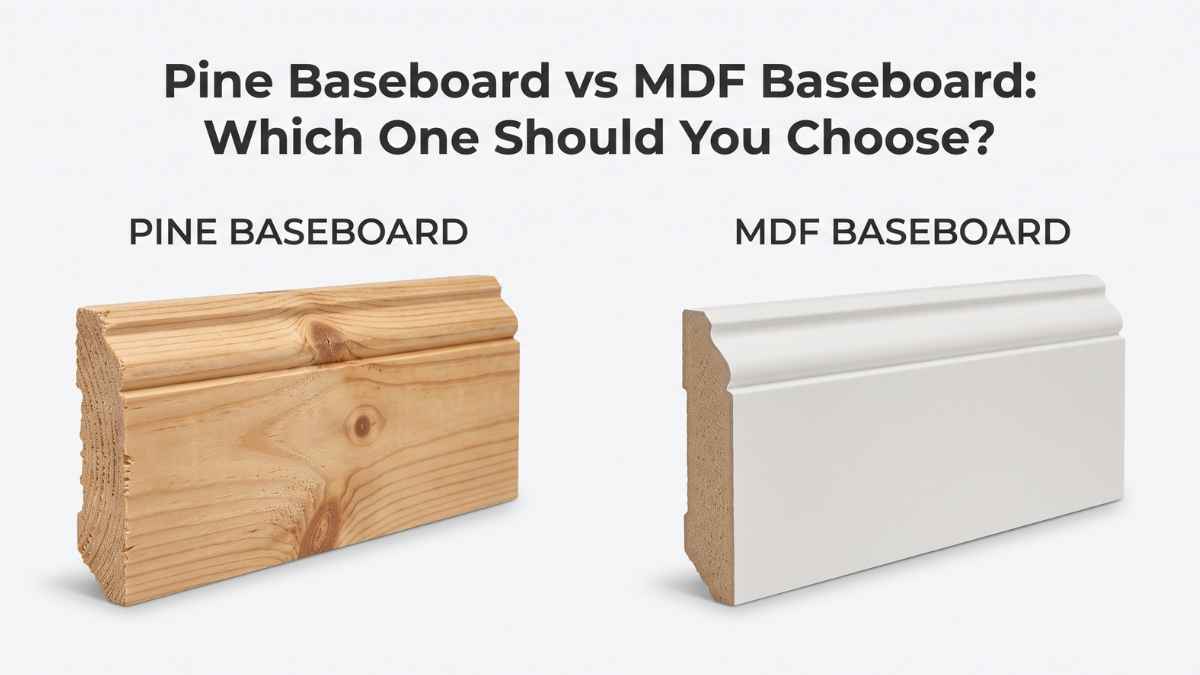
Picking baseboard seems like a small decision until you’re standing in the trim aisle comparing two budget-friendly options that look nearly identical once they’re painted. Pine baseboard and MDF baseboard are two of the most popular choices for homeowners, but they’re built from very different materials and they behave differently over time. This guide walks through the details so you can match the right trim to the right room.
The Basics: What Each One Is
Pine baseboard is real wood. It’s cut from pine, a softwood, and it keeps the natural grain and character of the tree. You’ll find it as clear pine (few or no knots), knotty pine (rustic, with visible knots), solid pine (one continuous piece), and finger-jointed pine (short pieces glued end to end and usually primed).
MDF baseboard is engineered. MDF stands for medium-density fiberboard, made from fine wood fibers mixed with wax and resin, then pressed into dense panels and milled into trim profiles. It has no grain and no knots, and every board looks the same. Most MDF baseboard comes primed and ready to paint.
That one difference, real wood versus pressed fiber, drives almost everything else in this comparison.
Quick Comparison
| Feature | Pine Baseboard | MDF Baseboard |
| Material | Natural softwood | Engineered wood fibers and resin |
| Cost | Low to moderate | Usually the lowest |
| Paint finish | Good, but knots and grain can show | Very smooth and even |
| Stain finish | Yes, with a conditioner | No, paint only |
| Moisture tolerance | Fair, can warp or swell | Poor, swells and crumbles |
| Dent resistance | Dents easily | Chips at edges, dents under impact |
| Weight | Lighter | Heavier |
| Repairs | Easy to sand and fill | Harder once the core is exposed |
| Best for | Stained or painted trim in dry to moderate rooms | Painted trim in dry rooms |
Cost
Both materials are budget-friendly, and MDF generally comes out slightly cheaper. The gap is usually small on a single board, but it can add up if you’re trimming a whole house. Primed finger-jointed pine sits close to MDF in price, while clear solid pine costs more. Keep in mind that the cheapest board isn’t always the cheapest project. If MDF gets damaged by moisture and needs replacing, the savings disappear fast.
Appearance and Finish
This is where your personal taste matters most.
Pine gives you options. You can paint it for a classic white look, or you can stain it to show off the warm, light grain. Knotty pine is a favorite for cabins, cottages, and farmhouse spaces. The trade-off is that pine can be fussy. Knots can bleed resin through paint over time, which means you should seal them with a shellac-based primer. Pine can also stain unevenly, so a pre-stain wood conditioner is a smart extra step.
MDF is a paint-only material. Because it has no grain and no knots, it takes primer and paint beautifully, leaving a smooth, flawless surface that many people love for modern and traditional white trim. If you want the look of real wood grain, though, MDF simply can’t deliver it.
Moisture and Humidity
Moisture is the biggest dividing line between these two materials.
MDF is very sensitive to water. When standard MDF gets wet, it swells, and it doesn’t shrink back. Edges can bubble or crumble. A leaky pipe, a damp basement, or even a wet mop used too close to the board can cause lasting damage. Moisture-resistant MDF performs better, but it still isn’t made for wet areas.
Pine is not waterproof either, but it handles humidity better. It can swell, shrink, or warp as conditions change, yet it usually recovers more gracefully than MDF and doesn’t fall apart from a brief splash. If you must use either one in a humid room, seal every side, including the back and the cut ends.
For truly wet spaces like bathrooms and basements, PVC trim is often the better answer than either of these.
Durability and Wear
Pine is a softwood, so it dents and scratches easily. Furniture, vacuum cleaners, pet claws, and kids’ toys can leave marks. The good news is that damage is usually easy to fix. You can fill dings with wood filler, sand them smooth, and repaint.
MDF has a hard, smooth surface that resists small scuffs reasonably well once painted. However, the corners and ends can chip, and nailing too close to the edge can split the board. When the surface breaks, the soft inner core is exposed, and patching it neatly takes more effort. MDF also tends to lose its grip if you remove and reinstall it.
Installation and Workability
Both materials are friendly to DIYers, but they have different quirks.
Pine is lightweight, nails in easily, and cuts cleanly with a miter saw. It’s forgiving, and it holds fasteners well. It can occasionally be warped or twisted, so it’s worth sorting through the stack and picking straight boards.
MDF arrives straight and consistent, which helps corners meet tightly. It also cuts crisply and comes in long lengths. On the downside, it’s heavier, and it’s more likely to split near the ends, so pre-drilling nail holes is a good habit. Cutting MDF also produces a lot of fine dust, and many MDF products contain urea-formaldehyde resin. Cut it outdoors or in a well-ventilated area, and wear a dust mask or respirator and eye protection. Pine dust is a nuisance too, so protection is smart with both, but MDF dust is finer and more of a concern.
Stability Over Time
MDF doesn’t have a grain, so it doesn’t expand and contract with the seasons the way solid wood does. In a dry, stable home, that means fewer open joints and less caulk cracking. Pine moves slightly as humidity changes, which can open small gaps at joints or along the wall over the years. A bit of caulk and periodic touch-ups usually handle that.
Health and Environmental Notes
Once MDF is sealed with primer and paint, finished trim is generally considered fine for indoor use. If formaldehyde is a worry in your home, look for products labeled low-emission or formaldehyde-free. Pine is a natural material and is often available from responsibly managed forests, so check for certification if sustainability matters to you. MDF does make use of wood scraps that might otherwise go to waste, which some buyers appreciate.
Which One Should You Choose?
Choose pine baseboard if:
- You want the option to stain the trim and show real wood grain.
- Your home has moderate humidity or the occasional damp area.
- You like repairs to be simple, with filling and sanding.
- You prefer a lighter board that’s easy to carry and nail.
Choose MDF baseboard if:
- You plan to paint and want the smoothest possible finish.
- You’re working with a tight budget across many rooms.
- The space is dry and stable, such as bedrooms, hallways, and living rooms.
- You want boards that arrive straight and consistent.
Final Thoughts
There’s no single winner here. Pine baseboard is the more flexible, forgiving choice, with real wood character and easier repairs. MDF baseboard is the budget-friendly, ultra-smooth choice for painted trim in dry spaces.
Think about your finish, your room’s moisture level, and how much wear the trim will see, and the right pick usually becomes clear. Whichever you choose, prime and seal the cut ends, caulk the seams, and take your time with the install, and your baseboard will look sharp for many years.